
Cephalosporin Market: Comprehensive Analysis, Growth Outlook, and Strategic Insights
1. Introduction
The cephalosporin market represents a vital segment of the global pharmaceutical industry, driven by the growing need for effective antibacterial therapies. Cephalosporins are a class of β-lactam antibiotics widely prescribed for treating a broad range of bacterial infections, including respiratory tract infections, skin infections, urinary tract infections, and sepsis. Their broad-spectrum efficacy and improved safety profile compared to earlier antibiotics have made them a cornerstone of modern clinical practice.
In the current global healthcare landscape, the relevance of cephalosporins has increased due to rising infection rates, hospital-acquired diseases, and the expanding elderly population. The market also plays a significant role in public health systems, particularly in managing infectious disease outbreaks and antimicrobial resistance strategies.
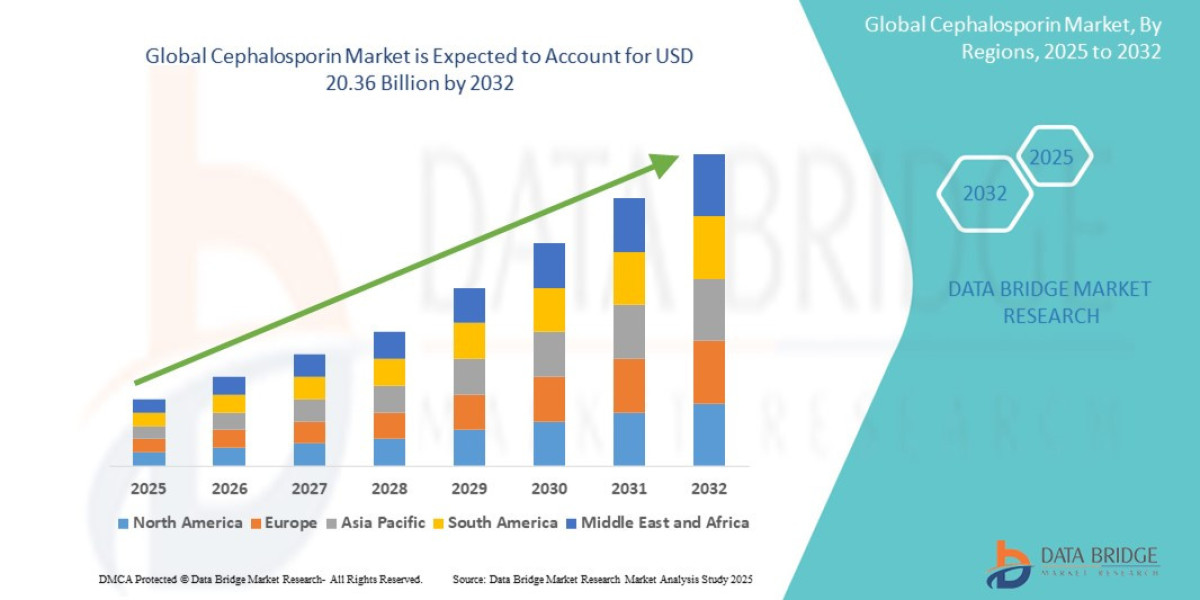
Looking ahead, the cephalosporin market is expected to experience steady growth, supported by continuous product innovation, rising healthcare expenditure, and increased access to antibiotics in developing economies. The global market is forecast to grow at a compound annual growth rate (CAGR) of approximately 4.5% to 5.5% between 2024 and 2032, reflecting sustained demand across both developed and emerging regions.
Get strategic knowledge, trends, and forecasts with our Cephalosporin Market. Full report available for download:
https://www.databridgemarketresearch.com/reports/global-cephalosporins-market
2. Market Overview
The cephalosporin market encompasses the production, distribution, and sale of first through fifth-generation cephalosporin antibiotics in various formulations, including oral tablets, capsules, and injectable forms. The market size is estimated to be in the multi-billion-dollar range, with consistent revenue contribution from both branded and generic drugs.
Historically, cephalosporins gained prominence in the late 20th century as safer alternatives to penicillin. Over time, successive generations were developed to address evolving bacterial resistance patterns and improve therapeutic outcomes. Today, the market is well-established, with a strong presence in hospital settings and outpatient care.
From a demand-supply perspective, demand remains high due to frequent prescribing and inclusion in essential medicines lists across multiple countries. On the supply side, the market benefits from a robust manufacturing base, particularly in Asia-Pacific, which serves as a major hub for active pharmaceutical ingredients (APIs) and finished formulations. However, supply can be affected by regulatory scrutiny, quality compliance issues, and raw material price fluctuations.
3. Key Market Drivers
Several factors contribute to the sustained growth of the cephalosporin market:
Rising Burden of Infectious Diseases
The increasing prevalence of bacterial infections globally continues to drive demand for effective antibiotics. Urbanization, lifestyle changes, and population density contribute to the spread of infections, particularly in developing regions.
Technological Advancements in Drug Development
Advances in pharmaceutical manufacturing, formulation science, and drug delivery technologies have improved the efficacy and shelf life of cephalosporins. Enhanced formulations with better bioavailability support wider clinical adoption.
Growth in Hospital and Surgical Procedures
The rise in surgical interventions, trauma cases, and intensive care admissions has led to increased use of injectable cephalosporins for prophylaxis and treatment, especially in hospital settings.
Government Healthcare Initiatives
Public healthcare programs, especially in emerging economies, have expanded access to essential antibiotics. Inclusion of cephalosporins in national formularies and reimbursement schemes has boosted consumption.
Expansion of Generic Drug Manufacturing
Patent expirations have enabled widespread production of generic cephalosporins, making them more affordable and increasing market penetration across price-sensitive regions.
4. Market Challenges
Despite its growth potential, the cephalosporin market faces several challenges:
Antimicrobial Resistance (AMR)
The misuse and overuse of antibiotics have led to rising resistance, reducing the effectiveness of some cephalosporin generations. This presents a long-term risk to market sustainability.
Stringent Regulatory Requirements
Regulatory authorities impose strict quality, safety, and manufacturing standards. Compliance failures can result in product recalls, facility shutdowns, and financial losses.
Intense Market Competition
The presence of numerous generic manufacturers has led to pricing pressure, particularly in mature markets. This reduces profit margins and limits investment capacity for innovation.
Supply Chain and Operational Risks
Dependence on specific raw materials and geographic regions for API production exposes the market to supply disruptions caused by geopolitical issues or trade restrictions.
5. Market Segmentation
By Type / Category
First-Generation Cephalosporins
Second-Generation Cephalosporins
Third-Generation Cephalosporins
Fourth-Generation Cephalosporins
Fifth-Generation Cephalosporins
Among these, third- and fourth-generation cephalosporins account for the largest market share due to their broad-spectrum activity and high clinical demand.
By Application / Use Case
Respiratory tract infections
Skin and soft tissue infections
Urinary tract infections
Gastrointestinal infections
Sepsis and severe systemic infections
Hospital-based applications dominate the market, with rising demand for injectable formulations.
By Region
North America
Europe
Asia-Pacific
Latin America
Middle East & Africa
The Asia-Pacific region is the fastest-growing segment, driven by expanding healthcare infrastructure and increasing pharmaceutical production.
6. Regional Analysis
North America
North America holds a significant share of the cephalosporin market due to advanced healthcare systems, high awareness, and strong hospital demand. The region focuses heavily on antimicrobial stewardship and regulated antibiotic use.
Europe
Europe demonstrates stable growth supported by public healthcare systems and strong regulatory oversight. Western Europe dominates regional consumption, while Eastern Europe shows rising demand.
Asia-Pacific
Asia-Pacific is the fastest-growing region, fueled by large patient populations, increasing healthcare spending, and a strong pharmaceutical manufacturing base. Countries such as China and India play a dual role as major consumers and suppliers.
Latin America
Latin America presents moderate growth opportunities due to improving healthcare access and increasing government investments in infectious disease management.
Middle East & Africa
This region shows emerging potential, driven by healthcare infrastructure development and international aid programs, though access disparities remain a challenge.
7. Competitive Landscape
The cephalosporin market is moderately fragmented, with a mix of global pharmaceutical companies and regional generic manufacturers. Key players focus on strategies such as:
Product innovation through improved formulations and combination therapies
Cost competitiveness via efficient manufacturing and economies of scale
Strategic partnerships and licensing agreements
Mergers and acquisitions to expand geographic presence and product portfolios
Competition is particularly intense in the generic segment, while branded products maintain strength in specialized hospital settings.
8. Future Trends & Opportunities
Over the next 5–10 years, several trends are expected to shape the cephalosporin market:
Development of next-generation cephalosporins targeting resistant strains
Increased use of combination therapies to enhance effectiveness
Growth in outpatient and home-based antibiotic therapy
Digital health integration for prescription monitoring and antimicrobial stewardship
Opportunities exist for manufacturers to invest in research, sustainable production, and emerging markets. Policymakers can support market growth through balanced regulations that promote innovation while preventing misuse.
The market’s forecasted CAGR of 4.5%–5.5% indicates stable long-term expansion with room for strategic investment.
9. Conclusion
The cephalosporin market remains a critical component of global healthcare, addressing essential needs in infection control and patient care. Driven by rising disease prevalence, healthcare expansion, and pharmaceutical innovation, the market demonstrates strong resilience despite regulatory and resistance-related challenges.
With consistent growth prospects and expanding demand in emerging regions, the cephalosporin market offers long-term potential for manufacturers, investors, and healthcare stakeholders. Strategic focus on quality, innovation, and responsible use will be key to sustaining growth and maintaining therapeutic relevance in the years ahead.
Frequently Asked Questions (FAQs)
Q1: What is driving growth in the cephalosporin market?
Growth is driven by rising bacterial infections, hospital demand, generic drug expansion, and increasing healthcare access globally.
Q2: Which cephalosporin generation is most widely used?
Third-generation cephalosporins are the most widely used due to their broad-spectrum activity and versatility.
Q3: What is the expected CAGR of the cephalosporin market?
The market is forecast to grow at a CAGR of approximately 4.5% to 5.5% over the next decade.
Q4: Which region shows the highest growth potential?
Asia-Pacific is expected to witness the fastest growth due to population size, manufacturing capacity, and healthcare expansion.
Q5: What are the main challenges facing the market?
Key challenges include antimicrobial resistance, strict regulatory requirements, pricing pressure, and supply chain risks.
Browse More Reports:
Global Subcutaneous Nucleic Acid Therapeutics Market
Global Sufentanil Market
Global Sunglasses Coating Market
Global Surgical Lasers Market
Global Surgical Rasps Market
Global Surgical Stents Market
Global Synthetic Biology Platforms Market
Global Telecom Mobile Virtual Network Operator Market
Global Textile Waterproofing Agents Market
Global Thin Film Transistor (TFT) Display Market
Global Thin Insulation Market
Global Tire Cutting Machine Market
Global Trichlorosilane Market
Global Two Wheeler Crash Guard Market
Global Ultrasonic Dissection Products Market
About Data Bridge Market Research:
An absolute way to forecast what the future holds is to comprehend the trend today!
Data Bridge Market Research set forth itself as an unconventional and neoteric market research and consulting firm with an unparalleled level of resilience and integrated approaches. We are determined to unearth the best market opportunities and foster efficient information for your business to thrive in the market. Data Bridge endeavors to provide appropriate solutions to the complex business challenges and initiates an effortless decision-making process. Data Bridge is an aftermath of sheer wisdom and experience which was formulated and framed in the year 2015 in Pune.
Contact Us:
Data Bridge Market Research
US: +1 614 591 3140
UK: +44 845 154 9652
APAC : +653 1251 975
Email:- corporatesales@databridgemarketresearch.com
"